

Cooking fumes
Fumus culinae
Smoke alarm, 6:42 PM.
Dinner was going fine until the garlic bread. Now someone is waving a dish towel at the ceiling and the dog has left the room.
oh wow: The beeping is the loud part. The quiet part is in the air: burning food during cooking quickly produces large quantities of indoor PM,[1] and the process of cooking itself can increase indoor PM too.[1] Gas stoves bring a second guest: EPA lists unvented combustion appliances, like gas stoves, among the primary indoor sources of nitrogen dioxide.[2]
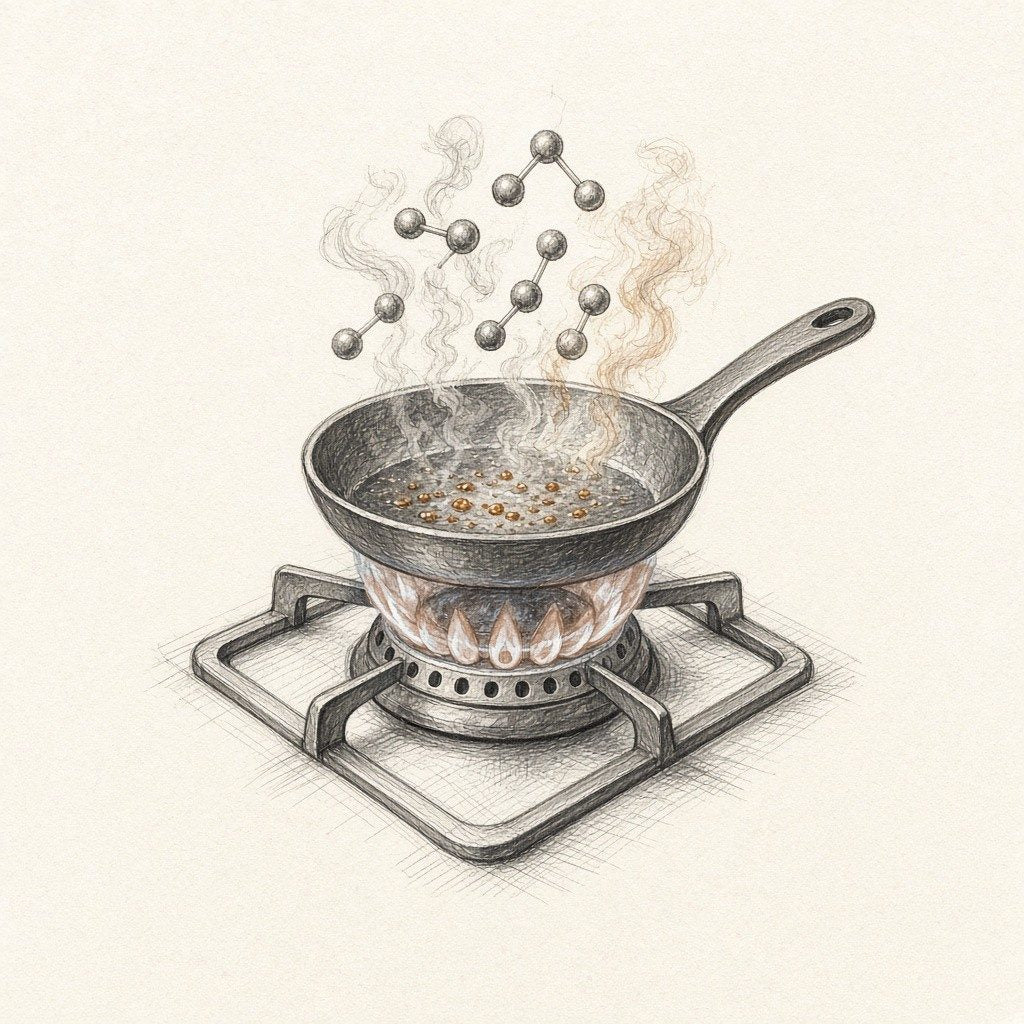
Cooking fumes are a mix: particles from the food and the cooking itself,[1] plus gases like nitrogen dioxide from combustion.[2] Their one weakness is the range hood. EPA says using one while cooking can greatly reduce indoor PM exposure from cooking.[1]
Tap any tag to see everything else that shares it.
Spot it: Sometimes. Some particles, like smoke, are large or dark enough to see; others can only be detected with an electron microscope.[4]
“Dinner smells amazing. The stove has notes.”
The short version
What cooking fumes actually are
Two things at once. Many cooking appliances and the process of cooking itself can increase indoor PM,[1] and combustion adds gases such as nitrogen dioxide, a highly reactive oxidant.[2] Here’s a stove, start to finish.

- the pan. Food type, method (grilling, frying, baking, sautéing) and cooking fat all matter.[1]
- the flame. Unvented gas stoves are a primary indoor source of NO2.[2]
- the hood. Use it whenever you cook, vent it outdoors if possible, and leave it on 10 to 20 minutes after.[1]
- the window. No hood? Open windows or doors, when safe, to bring fresh air in.[1]
Words, untangled
- PMparticle pollution
- A mixture of solid particles and liquid droplets in the air.[4]
- NO2nitrogen dioxide
- A toxic, highly reactive gas from combustion.[2]
- Range hoodthe exhaust
- Best when it vents outdoors instead of just recirculating the air.[1]
- Smoke pointthe oil’s limit
- EPA suggests oils with higher smoke points, like canola and peanut, for high-heat cooking.[1]

Myths, meet sources
Many cooking appliances and the process of cooking itself can increase indoor PM. Burning just makes a lot more, quickly.[1]
EPA: the best choice is a range hood that vents to the outdoors instead of one that just recirculates the air.[1]
EPA says leave it on for 10 to 20 minutes after you’re done cooking.[1]
Only in homes without combustion appliances, where it averages about half of outdoors. With gas stoves, kerosene heaters or unvented gas space heaters, indoor levels often exceed outdoor levels.[2]

Some people, not everybody
“NO2 acts mainly as an irritant affecting the mucosa of the eyes, nose, throat and respiratory tract.”US EPA, Nitrogen Dioxide’s Impact on Indoor Air Quality [2]
“Nitrogen dioxide (NO2) is an odorless gas that can irritate your eyes, nose and throat and cause shortness of breath.”US EPA, Asthma Triggers: Gain Control [5]
Our part: we describe what the agencies say, word for word where it matters, not what it means for any one person.
Questions people ask
Why the back burner?
It improves air flow to the hood and reduces the PM released into your kitchen.[1]
How long should the hood run?
The whole time you cook on the stove or in the oven, and 10 to 20 minutes after.[1]
No range hood. Now what?
Open windows or doors when safe, and turn on a wall or ceiling exhaust fan if you can.[1]
Which oil makes less smoke?
For high heat, EPA suggests oils with higher smoke points, such as canola and peanut.[1]
Can a strong hood cause problems?
In some cases. High-airflow hoods can cause combustion backdrafting, drawing carbon monoxide from a gas water heater or furnace into living areas. EPA suggests consulting a professional.[1]
Is there an indoor NO2 standard?
No standards have been agreed upon for nitrogen oxides in indoor air.[2]
Sources
- [1]US EPA, Sources of Indoor Particulate Matter (PM)Agency guide
- [2]US EPA, Nitrogen Dioxide’s Impact on Indoor Air QualityAgency guide
- [3]US EPA, Residential Air Cleaners: A Technical Summary, 3rd ed. (2018)Agency guide
- [4]US EPA, Particulate Matter (PM) BasicsAgency guide
- [5]US EPA, Asthma Triggers: Gain ControlAgency guide
Citing an agency or study doesn’t mean it endorses any product. Field names are ours. The science isn’t.
