

Airborne microbes
Aerosolum vivum
The dog comes home.
Back from the park, muddy paws, tail going. One lap of the living room, a happy shake on the rug, and a slow drift of dust settles back down in the window light.
oh wow: That lap moved a crowd. Most microorganisms indoors come from people, pets, pests, air, water and areas of active microbial growth, and once they settle, they can re-enter the air when settled dust is stirred up.[1] Every home has its own mix: every building has a microbiome, but there is no normal or typical one.[1]
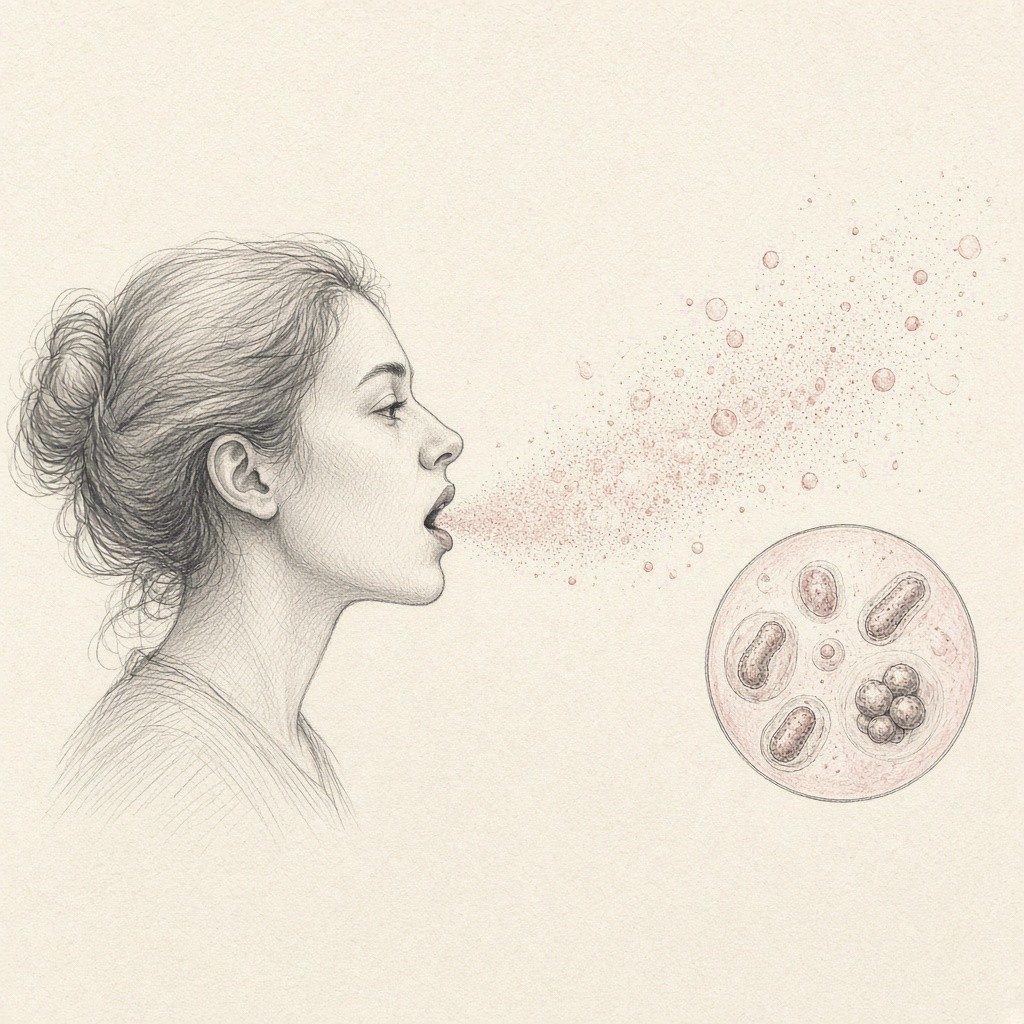
Airborne microbes are part of the indoor microbiome: bacteria, viruses, fungi and other single-celled organisms, plus their fragments and by-products.[1] Some microorganisms will always be present indoors.[1] Their one weakness is moisture. EPA says preventing conditions like excessive moisture is usually the most effective first step.[2]
Tap any tag to see everything else that shares it.
Spot it: Not by eye. Viruses and some bacteria are among the fine particles in a home.[3]
“Every conversation leaves a little in the air.”
The short version
What airborne microbes actually are
Living things too small to see, and the bits they leave behind. The indoor microbiome includes bacteria, viruses, fungi and other single-celled organisms, growing or inactive, plus fragments and chemicals they produce.[1] Here’s where a room’s crowd comes from.

- people. A main source of indoor microorganisms.[1]
- pets. Bacteria are emitted by human and pet occupants.[3]
- air and water. Microbes also come in from air and water.[1]
- the rug. Settled microbes re-enter the air when dust is stirred up.[1]
Words, untangled
- Microbiomethe whole crowd
- All the living microorganisms in an indoor space, plus their fragments and by-products.[1]
- Resuspensionthe second launch
- Stirring up settled dust or dirt, which sends microbes back into the air.[1]
- Biological contaminantsEPA’s umbrella
- Bacteria, viruses, fungi such as mold, dust mites, pollen, pet allergens and pests.[2]

The family
- Bacteria. Enter homes from outdoors and are emitted by human and pet occupants.[3]
- Viruses. Among the fine particles found in a home.[3]
- Fungi. Including mold, on EPA’s list of biological contaminants.[2]
- Fragments. Bits of microorganisms and chemicals they produce count as part of the microbiome too.[1]
Myths, meet sources
Some microorganisms will always be present indoors,[1] and EPA says it’s neither possible nor desirable to completely remove biological contaminants.[2]
They can have neutral, adverse or beneficial effects, depending on the person, their health, the microorganism and other variables.[1]
EPA: in general, testing for microorganisms is not necessary. It’s generally expensive and usually done for research.[1]
Settled microbes can re-enter the air by resuspension as people and pets move around.[1]

Some people, not everybody
“Some individuals can be more sensitive to exposure to certain biological contaminants.”US EPA, Biological Contaminants and Indoor Air Quality [2]
“Much remains unknown about the direct and indirect connections between humans and the indoor microbiome.”US EPA, Indoor Microbiome [1]
Our part: we describe what the agencies say, word for word where it matters, not what it means for any one person.
Questions people ask
What counts as an airborne microbe?
Bacteria, viruses, fungi and other single-celled organisms, and their fragments.[1]
Where do they come from?
People, pets, pests, air, water and areas of active microbial growth indoors.[1]
Is there a healthy level?
There’s no standard for a “normal” or “healthy” indoor microbiome.[1]
Should I test my home?
Generally not necessary, EPA says.[1]
What actually helps?
EPA’s order: source control first, then ventilation, bringing in outdoor air when it’s safe and using kitchen and bathroom exhaust fans.[2]
What about visible mold?
Properly maintained indoor spaces should not have visible mold or other microbial growth. If mold growth is visible, it should be addressed promptly.[1]
Sources
- [1]US EPA, Indoor MicrobiomeAgency guide
- [2]US EPA, Biological Pollutants’ Impact on Indoor Air QualityAgency guide
- [3]US EPA, Residential Air Cleaners: A Technical Summary, 3rd ed. (2018)Agency guide
Citing an agency or study doesn’t mean it endorses any product. Field names are ours. The science isn’t.
