

Dust mites
Dermatophagoides
The sofa cushion.
You flip the sofa cushion to hide a coffee ring, give it a pat, and a little cloud of dust puffs up in the lamplight. Somebody lives in there.
oh wow: Several somebodies. Dust mites are tiny bugs that are too small to see, and every home has dust mites.[1] They feed on flakes of dead skin shed by people and pets, and can live in upholstered furniture, carpets and curtains.[2]
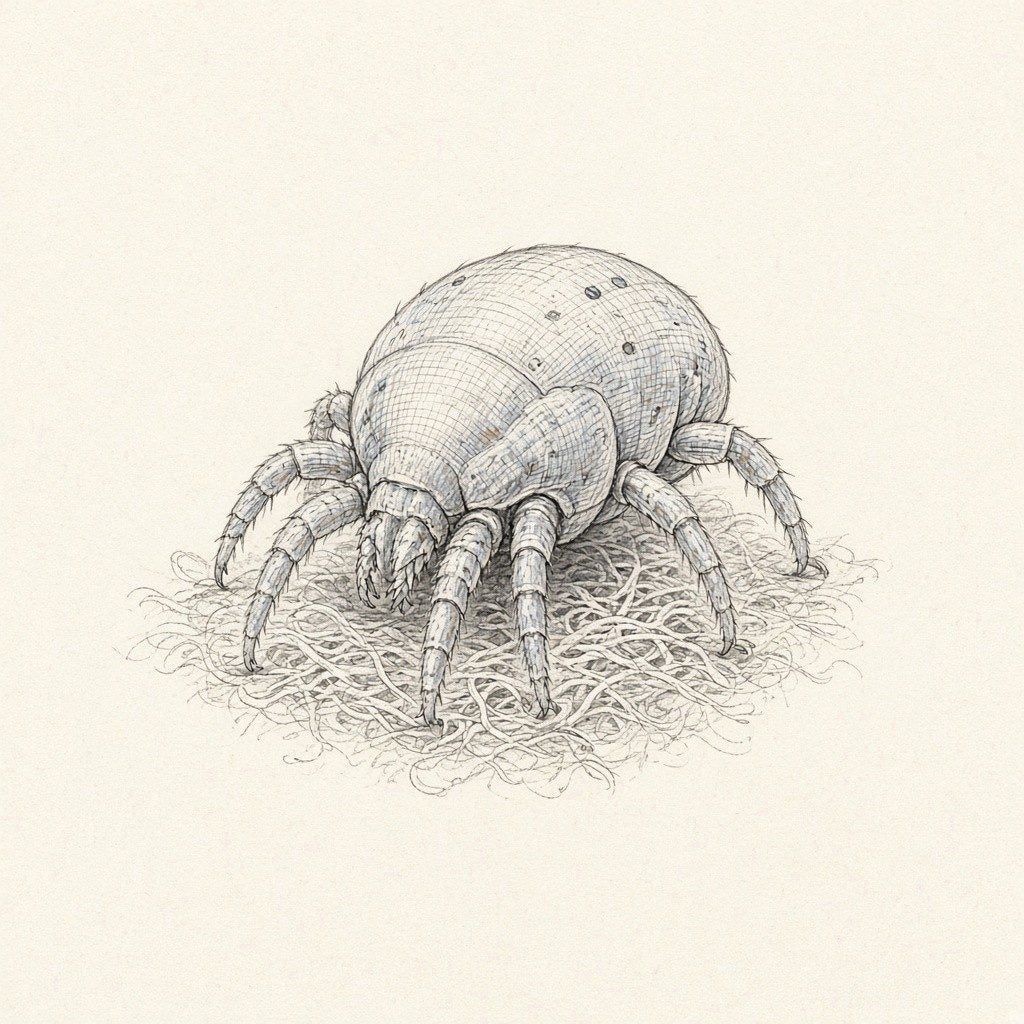
Dust mites are microscopic, insect-like pests that commonly live in house dust.[2] No matter how clean a home is, they cannot be completely eliminated.[2] Their one weakness is humidity: NIEHS suggests keeping it at, or below, 50 percent to reduce their numbers.[2]
Tap any tag to see everything else that shares it.
Hang time: Mostly settles. A significant fraction of dust mite body parts are among the larger particles in a home, and larger particles settle out of the air rather rapidly.[4]
Spot it: Not by eye. Dust mites are too small to see.[1]
“Tiny roommates. They do not pay rent.”
The short version
What dust mites actually are
Not dust, and not quite insects: microscopic, insect-like pests.[2] EPA counts dust mites among biological contaminants,[3] and it’s their body parts and droppings EPA points to.[1] Here’s one, up close.

- the skin flake. Food. Dust mites feed on flakes of dead skin, or dander, shed by people and pets.[2]
- the mite. Microscopic and insect-like.[2]
- the fabric. Home: upholstered furniture, carpets and curtains.[2]
- the droppings. Body parts and droppings are mostly larger particles.[4]
Words, untangled
- Dust mitethe tenant
- A microscopic, insect-like pest that commonly lives in house dust.[2]
- Danderthe menu
- Flakes of dead skin shed by people and pets.[2]
- Humiditythe lever
- NIEHS suggests keeping it at, or below, 50 percent.[2]

Myths, meet sources
“No matter how clean a home is, dust mites cannot be completely eliminated.”[2]
Dust mites are tiny bugs that are too small to see.[1]
NIEHS says use a damp mop or rag to remove dust, and never a dry cloth, as it stirs up allergens.[2]
EPA: every home has dust mites.[1]

Some people, not everybody
“These tiny creatures are a big source of allergens and can worsen allergies and asthma.”US NIEHS, Dust Mites and Cockroaches [2]
“People with asthma or allergies should leave the area being vacuumed.”US EPA, Asthma Triggers: Gain Control [1]
Our part: we describe what the agencies say, word for word where it matters, not what it means for any one person.
Questions people ask
What do dust mites eat?
Flakes of dead skin, or dander, shed by people and pets.[2]
Where do they live?
In house dust, upholstered furniture, carpets and curtains.[2] EPA adds stuffed toys and fabric-covered items.[1]
Can I get rid of them completely?
No. They can’t be completely eliminated, but their number can be reduced.[2]
What helps?
Humidity at, or below, 50 percent and a damp mop or rag for dust,[2] plus vacuuming carpets and furniture every week.[1]
Do they float around?
Mostly not. A significant fraction of their body parts are larger particles, and larger particles settle out of the air rather rapidly.[4]
Why wash stuffed toys?
EPA suggests choosing stuffed toys you can wash, washing them in hot water and drying them completely.[1]
Sources
- [1]US EPA, Asthma Triggers: Gain ControlAgency guide
- [2]US NIEHS, Dust Mites and CockroachesAgency guide
- [3]US EPA, Biological Pollutants’ Impact on Indoor Air QualityAgency guide
- [4]US EPA, Residential Air Cleaners: A Technical Summary, 3rd ed. (2018)Agency guide
Citing an agency or study doesn’t mean it endorses any product. Field names are ours. The science isn’t.
