

Ozone
Ozonum
A hot afternoon downtown.
Sun bouncing off the windshields, traffic barely moving, and the skyline looks washed out, like an old photograph left on the dashboard.
oh wow: Nobody put that ozone there. Ground-level ozone is not emitted directly into the air; it forms when pollutants from cars, power plants and other sources react in sunlight.[1] Same molecule as the ozone layer, opposite job: up high it shields us from the sun’s ultraviolet rays, and down here it’s a harmful air pollutant and the main ingredient in smog.[1]
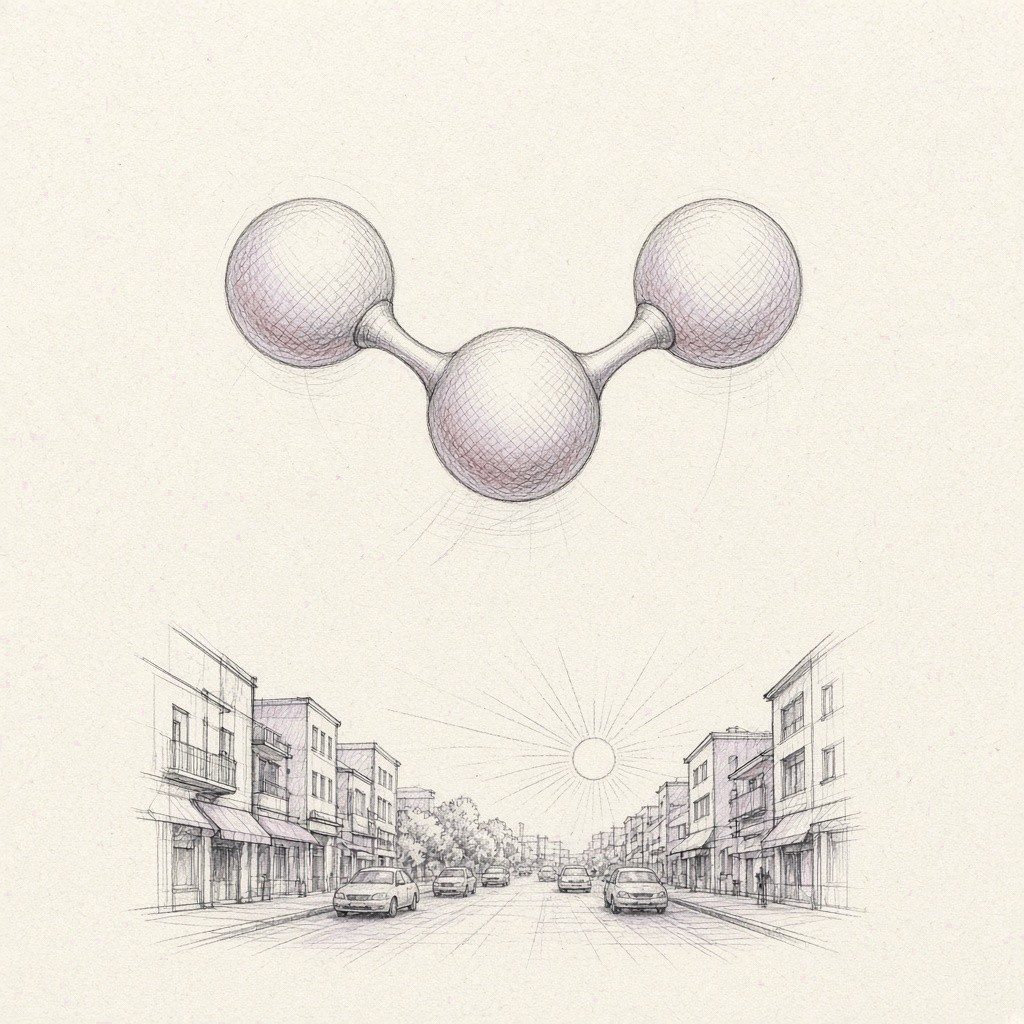
Ozone is a gas made of three oxygen atoms.[1] Some of the ozone indoors is brought in from outside.[2] Its one weakness: it’s forecast. You can check ozone levels and other daily air quality information at airnow.gov.[1]
Tap any tag to see everything else that shares it.
Spot it: Not by eye. Check the forecast: ozone is most likely to reach unhealthy levels on hot sunny days in cities.[1]
“Helpful up high in the sky. Rude down here.”
The short version
What ozone actually is
A molecule of three oxygen atoms. The third one can detach and re-attach to molecules of other substances, changing their chemical composition.[2] That reactivity is the whole story. Here it is, from sky to living room.

- up high. Stratospheric ozone forms a protective layer against the sun’s UV rays.[1]
- the recipe. Oxides of nitrogen plus VOCs plus sunlight, from cars, power plants and industry.[1]
- the window. Some indoor ozone is brought in from outside.[2]
- the new carpet. In a lab test, ozone plus new-carpet chemicals produced aldehydes, and total organic chemicals rose.[2]
Words, untangled
- Stratospheric ozonethe good kind
- Upper-atmosphere ozone that shields us from the sun’s ultraviolet rays.[1]
- Ground-level ozonethe bad kind
- A harmful air pollutant and the main ingredient in smog.[1]
- NOxoxides of nitrogen
- Half of the recipe, with VOCs, that forms ozone in sunlight.[1]
- Smogthe haze
- Ground-level ozone is its main ingredient.[1]

Myths, meet sources
Depends where. Up high it protects; at ground level it’s a harmful air pollutant.[1]
Ozone is most likely to reach unhealthy levels on hot sunny days, but can still reach high levels during colder months.[1]
Wind can carry ozone long distances, so even rural areas can experience high ozone levels.[1]
EPA notes experiments suggesting body odour may be masked by the smell of ozone but is not removed by ozone, and that ozone does not remove particles such as dust and pollen.[2]

Some people, not everybody
“People at greatest risk of harm from breathing air containing ozone include people with asthma.”US EPA, Ground-level Ozone Basics [1]
“People vary widely in their susceptibility to ozone.”US EPA, Ozone Generators that are Sold as Air Cleaners [2]
Our part: we describe what the agencies say, word for word where it matters, not what it means for any one person.
Questions people ask
How does ground-level ozone form?
Through chemical reactions between oxides of nitrogen and VOCs in sunlight.[1]
When is it worst?
On hot sunny days in cities, though it can still reach high levels in colder months.[1]
How do I check ozone where I live?
Air quality forecasts often come with the weather. EPA points to airnow.gov and, in many areas, notifications through enviroflash.info.[1]
Does ozone react with things indoors?
Yes. In a lab experiment with chemicals from new carpet, the reaction produced a variety of aldehydes, and total organic chemicals in the air increased.[2]
Has the government approved ozone machines for homes?
No. EPA: “NO agency of the federal government has approved these devices for use in occupied spaces.”[2]
Does ozone remove dust or pollen?
No. Ozone does not remove particles, such as dust and pollen, from the air.[2]
Sources
- [1]US EPA, Ground-level Ozone BasicsAgency guide
- [2]US EPA, Ozone Generators that are Sold as Air CleanersAgency guide
Citing an agency or study doesn’t mean it endorses any product. Field names are ours. The science isn’t.
