

Air and you: what the research actually says
Umpires, chess players, office workers and kids in classrooms. What researchers found when they lined up people's work with the air around them, and how to read it.
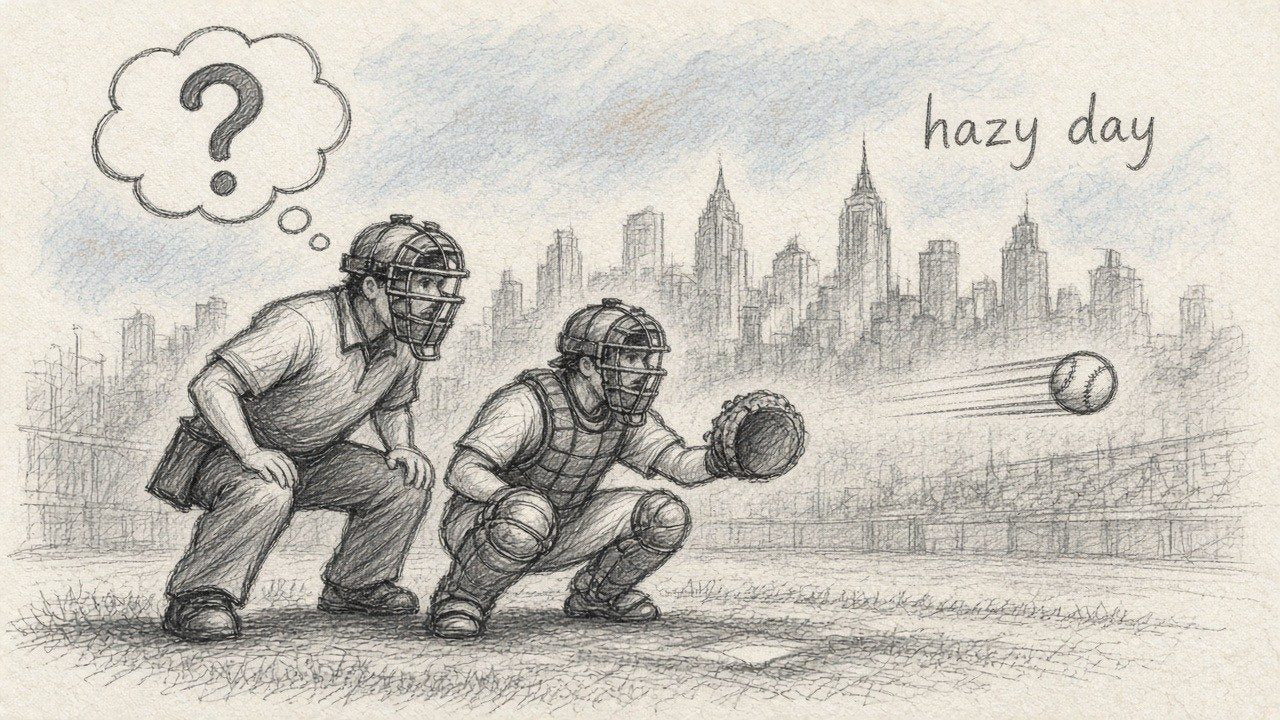
From the notebook · a ballpark, the seventh inning
Bottom of the seventh. The pitch comes in at the knees, the umpire's arm goes up, and forty thousand people have an opinion.
Nobody in the stands is thinking about the air. Economists did. They followed professional baseball umpires, call after call, and lined their decisions up with the air quality.[1]
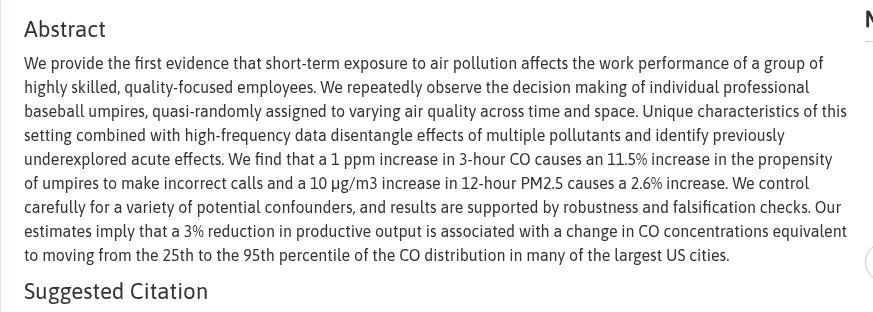
A 1 ppm rise in carbon monoxide went with an 11.5% increase in the umpires' propensity to make incorrect calls. A 10 µg/m³ rise in PM2.5 went with a 2.6% increase.[1]
Even experts with great eyesight make more mistakes in dirtier air.
The easy version
- Umpires made more incorrect calls when carbon monoxide and PM2.5 were higher.[1]
- Office workers in six countries answered slower and less accurately when indoor PM2.5 was higher.[2]
- When researchers changed office air on purpose, cognitive scores were higher in the greener, better-ventilated setups.[3]
Read a study in two seconds
Before the studies, one tool. Ask what kind of study it is. Higher on the ladder means stronger evidence.
The research, room by room
Each card is a full page with the real paper, our pencil on it, and the caveats.
- Office air, The office: 302 workers, 12 months: more PM2.5 and less ventilation went with slower, less accurate answers.[2]
- Stuffy meeting rooms, The meeting room: Decision scores dropped on six of nine scales at 1,000 ppm CO2.[4]
- Chess and indoor air, The chess hall: 10 µg/m³ more indoor PM2.5 raised a player’s probability of an erroneous move by 26.3%.[5]
- Classroom filters, The classroom: Air filters went in, and scores rose 0.20 standard deviations.[6]
- Window open or closed?, The dorm room: Lower bedroom CO2 went with better next-day logical-thinking scores.[7]
- Ventilation and sick leave, The company offices: Lower ventilation went with a 1.53 relative risk of short-term sick leave.[8]
Even umpires
Here's the real paper. Notice the word they use: causes. They earned it with a careful design.
Umpires were quasi-randomly assigned to varying air quality across time and space, which is why the authors could say more than "linked."[1] They also report that the results are supported by robustness and falsification checks.[1]
What this guide leaves out, and why
Agencies and medical journals cover air and disease in depth. This guide sticks to what you can notice in a normal day: rooms, habits, focus and decisions. We don't make medical claims, and we don't promise what any product will do for any one person.
Questions people ask
Does this mean a filter will make me sharper?
No study here tests any particular product, and none promises an outcome for one person. They show what tended to happen to groups.
Why so many observational studies?
Because you can't randomly assign whole cities to dirty air. That's why controlled experiments, like the CO2 chamber study, are so valuable.
Where to next
research, office-air-pm25-harvard, chess-indoor-air, classroom-air-filters-test-scores, stuffy-room-co2-decisions, air-101-why-care
Sources
- [1]Archsmith, Heyes & Saberian2018), J. of the Association of Environmental and Resource Economists 5(4
- [2]Cedeño Laurent et al. (2021), Environmental Research Letters 16:094047.
- [3]Allen et al.2016), Environmental Health Perspectives 124:805-812 (COGfx
- [4]Satish et al. (2012), Environmental Health Perspectives 120:1671-1677.
- [5]Künn, Palacios & Pestel2023), Indoor Air Quality and Strategic Decision Making, Management Science 69(9):5354-5377 (published abstract
- [6]Gilraine2020), Air Filters, Pollution and Student Achievement, EdWorkingPaper 20-188; Journal of Human Resources 60(5
- [7]Strøm-Tejsen et al. (2016), Indoor Air 26(5):679-686.
- [8]Milton, Glencross & Walters (2000), Indoor Air 10(4):212-221.
Citing an agency or study doesn’t mean it endorses any product. Field names are ours. The science isn’t.
