

Fine particles
Particula subtilis
A sunbeam through the blinds.
Late afternoon, and a stripe of light cuts across the living room. Inside it, little specks drift and spin like a slow snow globe. Pretty. Now look at the air just outside the stripe.
oh wow: The specks you can see are the big ones. Some particles, like dust, dirt, soot or smoke, are large or dark enough to see with the naked eye; others are so small they can only be detected with an electron microscope.[1] Fine particles are 2.5 micrometers and smaller, and the average human hair is about 70 micrometers wide, 30 times larger than the largest fine particle.[1] The sunbeam is showing you the extras. The stars of the show are invisible.
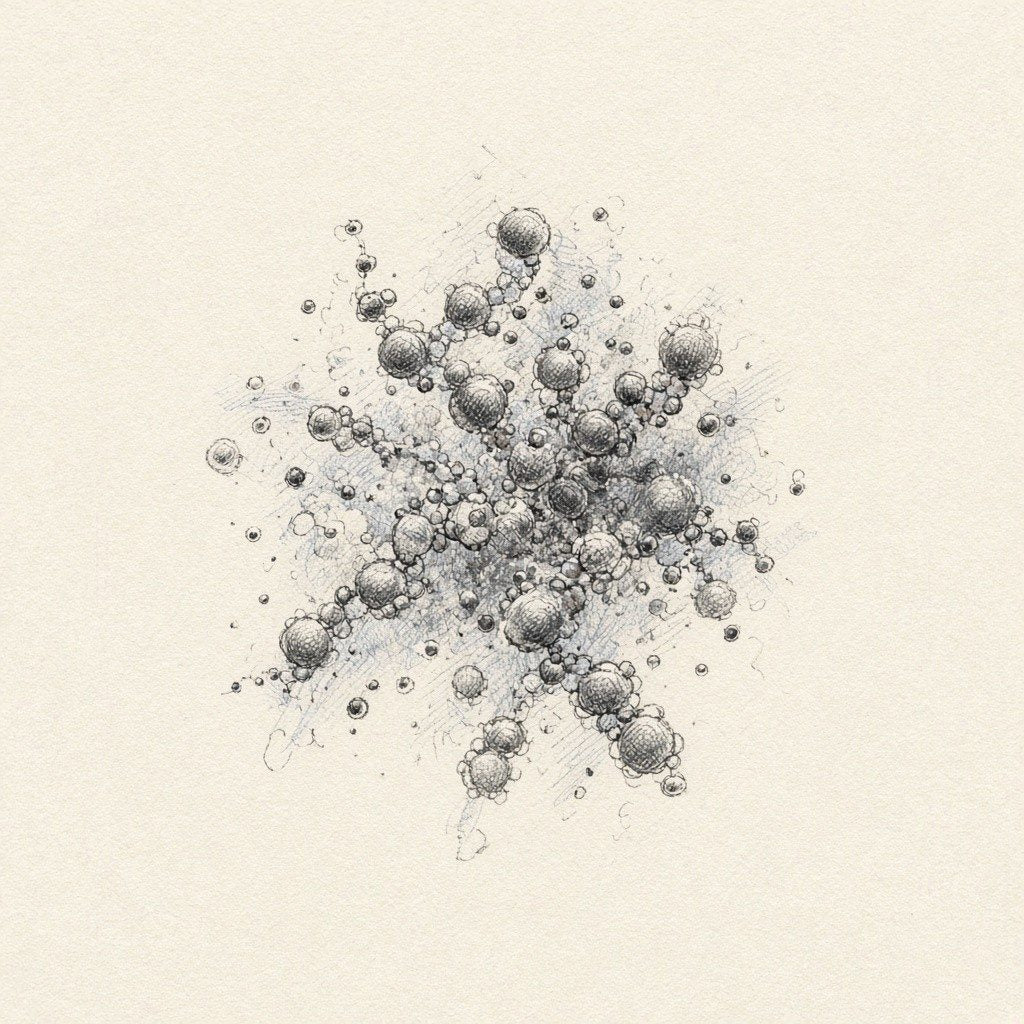
Fine particles, or PM2.5, are part of a mixture of solid particles and liquid droplets found in the air.[1] They’re found in all indoor environments.[2] Their one weakness: a lot of them start with something we do, so usually the best way to reduce indoor PM is to reduce its sources.[3]
Tap any tag to see everything else that shares it.
Spot it: Not by eye. The smallest particles can only be detected using an electron microscope.[1]
“Too small to see, too common to ignore.”
The short version
- Fine particles are 2.5 micrometers and smaller. An average hair is about 30 times wider than the largest one.[1]
- Indoors they come from outside, through windows, doors and cracks, and from inside: cooking, candles, fireplaces, unvented heaters, smoking, printers and even chemical reactions in the air.[3]
- EPA says particles under 2.5 micrometers pose the greatest risk to health,[1] and that less is known about the specific impacts of indoor PM on health.[2]
What fine particles actually are
PM stands for particulate matter, also called particle pollution: a mixture of solid particles and liquid droplets found in the air.[1] They come in many sizes and shapes and can be made up of hundreds of different chemicals.[1] EPA sorts them by size, so here they are, lined up from big to tiny.

- a human hair. About 70 micrometers across, on average.[1]
- pollen. EPA lists it first when ranking indoor particles from largest to smallest.[4]
- PM10. Inhalable particles, generally 10 micrometers and smaller.[1]
- PM2.5. Fine inhalable particles, generally 2.5 micrometers and smaller.[1]
Words, untangled
- PMparticulate matter
- The term for a mixture of solid particles and liquid droplets found in the air.[1]
- PM2.5the fine ones
- Fine inhalable particles, generally 2.5 micrometers and smaller.[1]
- PM10the inhalable ones
- Inhalable particles, generally 10 micrometers and smaller.[1]
- Micrometerthe ruler
- The unit EPA sizes particles in. An average hair is about 70 of them across.[1]

The family
- From outdoors. Car exhaust, smoke, road dust, pollen, some factory emissions and wildfires, carried in through doors, windows and cracks.[3]
- From the stove. Cooking is on EPA’s list of indoor PM sources.[3]
- From flames. Candles, fireplaces, unvented space heaters, kerosene heaters, tobacco and other smoking products.[3]
- From machines. Printers.[3]
- From life. Biological contaminants: animals, pests, plants and mold.[3]
- From thin air. Indoor chemical reactions, like the orange-peel one.[3]
Myths, meet sources
Some particles are large or dark enough to see. Others are so small they can only be detected using an electron microscope.[1]
EPA says indoor PM levels have the potential to exceed outdoor PM levels. In homes without smoking or other strong particle sources, EPA expects indoor PM to be the same as, or lower than, outdoor levels.[2]
Indoors, PM is generated by cooking, some cleaning activities, candles, fireplaces, unvented heaters, smoking products, pets, pests, plants, mold, printers and indoor chemical reactions.[3]
Outdoor and indoor air are constantly mixing together, so some outdoor air is always coming into your home. PM can also enter through small openings and cracks in walls and foundations.[3]

Some people, not everybody
“People with heart or lung diseases, children, older adults, minority populations, and low socioeconomic status populations are the most likely to be affected by particle pollution exposure, either because they are more sensitive or may have higher exposures.”US EPA, Health and Environmental Effects of PM [5]
“However, less is known about the specific impacts of indoor PM on health.”US EPA, Indoor Particulate Matter [2]
Our part: we describe what the agencies say, word for word where it matters, not what it means for any one person.
Questions people ask
How small is 2.5 micrometers?
Think of a single hair from your head: about 70 micrometers across, which makes it 30 times larger than the largest fine particle.[1]
Where does indoor PM come from?
Both places. Outdoor air brings particles in through windows, doors and small cracks, and indoors PM is made by cooking, combustion, some cleaning, printers and more.[3]
What’s the best way to lower it?
EPA: usually, the best way to reduce indoor PM is to reduce its sources. Some, like burning candles, can be stopped completely; others, like cooking and cleaning, can be controlled or reduced.[3]
Can peeling an orange really make particles?
EPA says chemicals in the air, such as those released from peeling an orange or using a cleaning solution, can react together to produce PM.[3]
What helps while cooking?
EPA suggests installing and using exhaust fans vented to the outside when cooking.[3]
How do I know when outdoor PM is high?
EPA points to AirNow, where the Air Quality Index tells you every day how clean or polluted your outdoor air is.[1]
Sources
- [1]US EPA, Particulate Matter (PM) BasicsAgency guide
- [2]US EPA, Indoor Particulate MatterAgency guide
- [3]US EPA, Sources of Indoor Particulate Matter (PM)Agency guide
- [4]US EPA, Residential Air Cleaners: A Technical Summary, 3rd ed. (2018)Agency guide
- [5]US EPA, Health and Environmental Effects of Particulate Matter (PM)Agency guide
Citing an agency or study doesn’t mean it endorses any product. Field names are ours. The science isn’t.
