

Pet dander
Furfur animalium
Coat on the hook.
A friend stops by after work, hangs a wool coat on the hook, and stays for one cup of tea. You don’t have a cat. Your friend does.
oh wow: That coat brought a guest. Pet allergens may be carried on clothing into areas where there are no pets.[1] In nationwide studies, dog and cat allergens were present in almost all U.S. homes, even those without pets.[1]
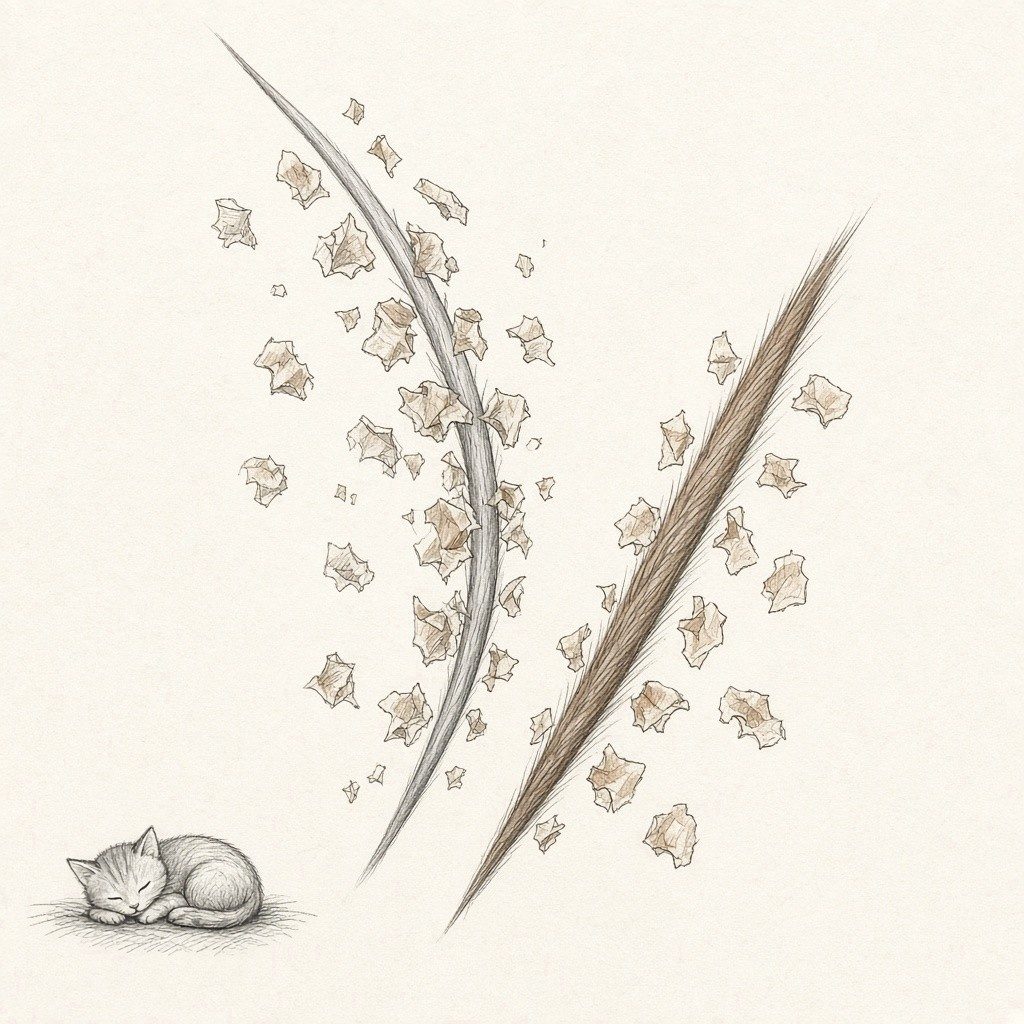
Pet dander is made of tiny, even microscopic, proteins from flecks of skin shed by pets.[1] Pet allergens circulate in air and can remain on carpets and furniture for months.[1] Its one weakness: it rides on things you can wipe, so the suggestions are wiping your pet’s feet before they come indoors[2] and dusting often with a damp cloth.[1]
Tap any tag to see everything else that shares it.
Hang time: Floats. Cat allergens are buoyant, which means they easily remain airborne.[1]
Spot it: You can’t. Pet dander is tiny, even microscopic.[1]
“Your cat isn't dusty. Your cat is generous.”
The short version
- Pet dander is tiny, even microscopic, proteins from flecks of skin shed by pets.[1]
- It travels: pet allergens circulate in air, stay on carpets and furniture for months, and ride on clothing to places with no pets.[1]
- Nationwide studies found dog and cat allergens in almost all U.S. homes, even homes without pets.[1]
What pet dander actually is
Fur isn’t the culprit. You may think animal allergies are caused by fur, but that fuzz and fluff is merely a carrier for allergens.[1] EPA counts pet allergens among the biological contaminants found indoors.[2] Here’s where it goes after it leaves the cat.

- the pet. Cat allergens come from saliva, skin glands and dander; dog allergens from dander, saliva, urine and blood.[1]
- the air. Cat allergens are buoyant and easily remain airborne.[1]
- the rug. Pet allergens can remain on carpets and furniture for months.[1]
- the coat. They may be carried on clothing into areas where there are no pets.[1]
Words, untangled
- Danderthe skin flecks
- Tiny proteins from flecks of skin shed by pets.[1]
- Allergenthe word
- A foreign substance that is normally harmless in most people.[4]
- Furthe carrier
- Merely a carrier for allergens, not the source.[1]

Myths, meet sources
Fuzz and fluff is merely a carrier for allergens. The source is dander: tiny proteins from flecks of skin.[1]
Nationwide studies found dog and cat allergens in almost all U.S. homes, even those without pets.[1]
Allergen levels can differ among breeds, but NIEHS says “all breeds, even hairless dogs, can trigger allergies.”[1]
Pet allergens can remain on carpets and furniture for months.[1] EPA says that after an animal leaves the home, it’s important to thoroughly clean the floors, walls, carpets and upholstered furniture.[5]

Some people, not everybody
“Millions of Americans live with pets despite being allergic to them.”US NIEHS, Pet Allergens [1]
“Pet allergies can also make asthma harder to control.”US NIEHS, Pet Allergens [1]
Our part: we describe what the agencies say, word for word where it matters, not what it means for any one person.
Questions people ask
Where does pet dander come from?
Flecks of skin shed by pets. Cat allergens are also found in saliva and the urine of male cats; dog allergens in dander, saliva, urine and blood.[1]
Is dander big or small?
Both. EPA places a significant fraction of cat and dog dander among the smaller particles in a home, and a smaller fraction among the larger ones.[3]
How long does it stick around?
Pet allergens can remain on carpets and furniture for months.[1]
Can it follow me somewhere pet-free?
Yes. These small particles may be carried on clothing into areas where there are no pets.[1]
How many homes have a pet?
NIEHS scientists found that more than 50% of households have a dog, cat, or both.[1]
Sources
- [1]US NIEHS, Pet AllergensAgency guide
- [2]US EPA, Biological Pollutants’ Impact on Indoor Air QualityAgency guide
- [3]US EPA, Residential Air Cleaners: A Technical Summary, 3rd ed. (2018)Agency guide
- [4]US NIEHS, AllergensAgency guide
- [5]US EPA, Asthma Triggers: Gain ControlAgency guide
Citing an agency or study doesn’t mean it endorses any product. Field names are ours. The science isn’t.
