

Wildfire smoke
Fumus silvestris
An orange afternoon.
The sun is a dim coin behind the haze, and everything outside looks like an old photograph. Inside, with the windows shut, the room feels like a safe little capsule.
oh wow: Here’s the twist: the capsule leaks. EPA says some of the smoke from outdoors can enter your home and make it unhealthy to breathe indoor air, too.[1] It gets in three ways: open windows and doors, fans and HVAC systems with a fresh air intake, and small openings, cracks and gaps around closed windows and doors.[1] And it travels: wildfire smoke can reach far away from where fires burn.[2]
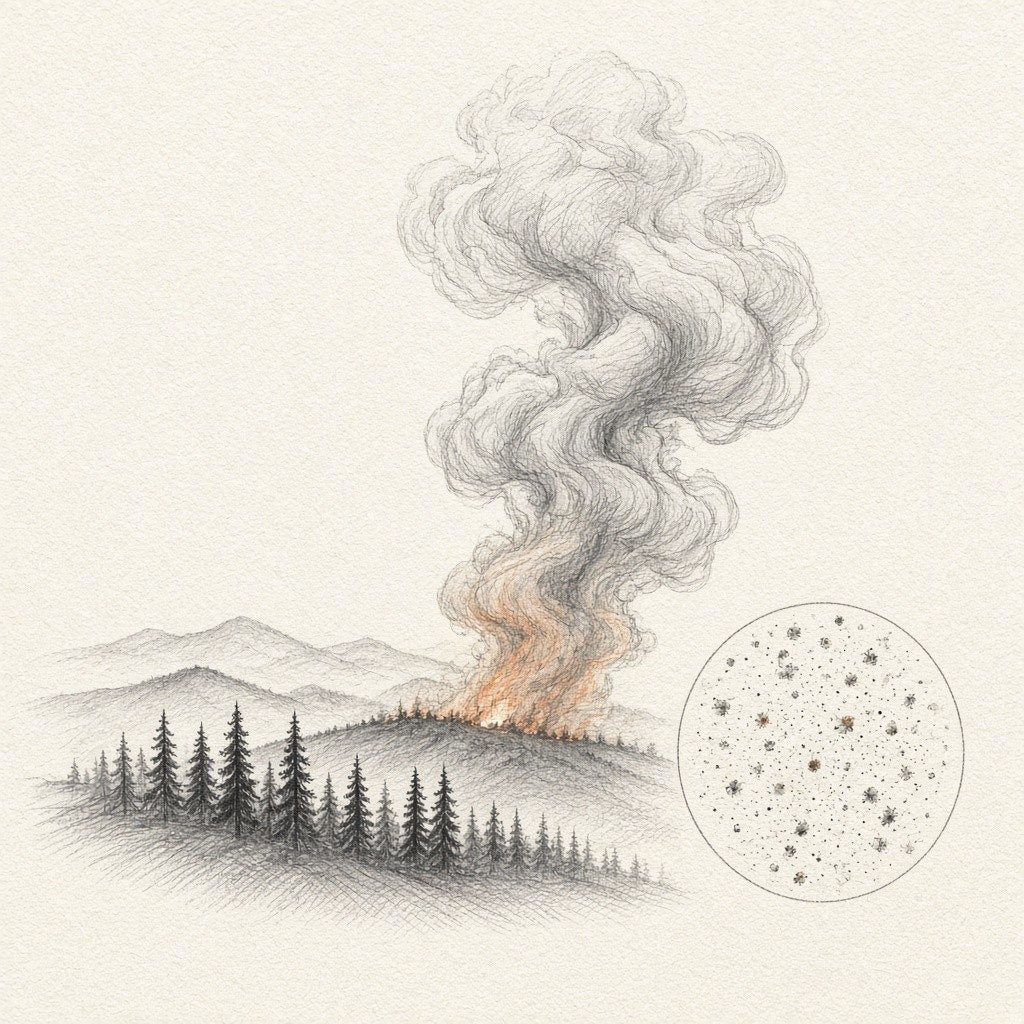
Wildfire smoke is a mix of gases and fine particles from burning trees and plants, buildings, and other material.[2] EPA says the biggest health threat from smoke is from fine particles.[1] Its one weakness: smoke events pass, and EPA says to use the times when outdoor air quality improves, even briefly, to air out the house.[1]
Tap any tag to see everything else that shares it.
Spot it: Sometimes by eye: smoke can be large or dark enough to see. The smallest particles in the air can only be detected with an electron microscope.[3]
“When the sky turns orange, the inside air matters most.”
The short version
What wildfire smoke actually is
Smoke is made up of a complex mixture of gases and fine particles produced when wood and other organic materials burn.[1] Here’s how it gets from the forest to the living room.

- the fire. Farther from a wildfire, you may be exposed to smoke even if the fire itself is far away.[1]
- the window. Open windows and doors: natural ventilation.[1]
- the vent. Fans that vent outdoors and HVAC systems with a fresh air intake: mechanical ventilation.[1]
- the cracks. Small openings, joints and cracks, and around closed windows and doors: infiltration.[1]
Words, untangled
- Natural ventilationwindows and doors
- Outdoor air coming in through open windows and doors.[1]
- Mechanical ventilationfans and intakes
- Bathroom or kitchen fans that vent outdoors, and HVAC systems with a fresh air intake.[1]
- Infiltrationthe sneaky one
- Air slipping in through small openings, joints, cracks, and around closed windows and doors.[1]
- Fine particlesthe main event
- The biggest health threat from smoke.[1]

Myths, meet sources
Outdoor air, including fine particles from wildfire smoke, can enter through small openings, joints, cracks, and around closed windows and doors.[1]
Wildfire smoke can reach far away from where fires burn.[2] EPA adds that smoke from a fire thousands of miles away is probably very small in amount and may be overshadowed by local sources.[1]
It’s a complex mixture of gases and fine particles.[1]
Ash on surfaces indoors and out can be inhaled if it becomes airborne when you clean up. EPA says to avoid dry sweeping and to mist hard surfaces with water first.[1]
Some people, not everybody
“Wildfire smoke can make anyone sick, but some people have a higher risk of getting sick.”US CDC, How Wildfire Smoke Affects Your Body [2]
“If you are healthy, you’re usually not at a major risk from short-term exposures to smoke.”US EPA, Wildfires and Indoor Air Quality [1]
“Being prepared for fire season is especially important for the health of children, older adults, and people with heart or lung disease.”US EPA, Wildfires and Indoor Air Quality [1]
Our part: we describe what the agencies say, word for word where it matters, not what it means for any one person.
Questions people ask
Where do I check the smoke?
EPA points to your local news, EPA’s AirNow website, or your state air quality website.[1]
Should the windows stay closed?
If local officials advise you to stay indoors, EPA says to keep windows and doors closed and use fans and air conditioning to stay cool.[1]
What about the HVAC fresh air intake?
EPA: set the system to recirculate mode, or close the outdoor intake damper.[1]
When can I air out the house?
When the air quality improves, even temporarily: open windows or the HVAC fresh air intake and run the kitchen and bathroom exhaust fans.[1]
What should I skip indoors on smoky days?
EPA lists smoking and vaping, gas, propane or wood-burning stoves and furnaces, spraying aerosol products, frying or broiling food, and burning candles or incense.[1]
How do I clean up ash?
Avoid stirring it up or dry sweeping. Mist hard surfaces with water first, then wet mop.[1]
Sources
- [1]US EPA, Wildfires and Indoor Air Quality (IAQ)Agency guide
- [2]US CDC, How Wildfire Smoke Affects Your BodyAgency guide
- [3]US EPA, Particulate Matter (PM) BasicsAgency guide
Citing an agency or study doesn’t mean it endorses any product. Field names are ours. The science isn’t.
