

Chemical fumes (VOCs)
Vapor organicus volatilis
A freshly painted room.
New color on the walls, drop cloths folded, windows cracked open. The paint is dry to the touch, but the room still has that brand-new smell, like a new notebook, only louder.
oh wow: That smell is a clue. Volatile organic compounds, VOCs, are emitted as gases from certain solids or liquids,[1] and paint is one of thousands of products that release them while you use them and, to some degree, while they sit in storage.[1] EPA’s TEAM study found about a dozen common organic pollutants 2 to 5 times higher inside homes than outside, whether the homes were in rural or highly industrial areas.[1]
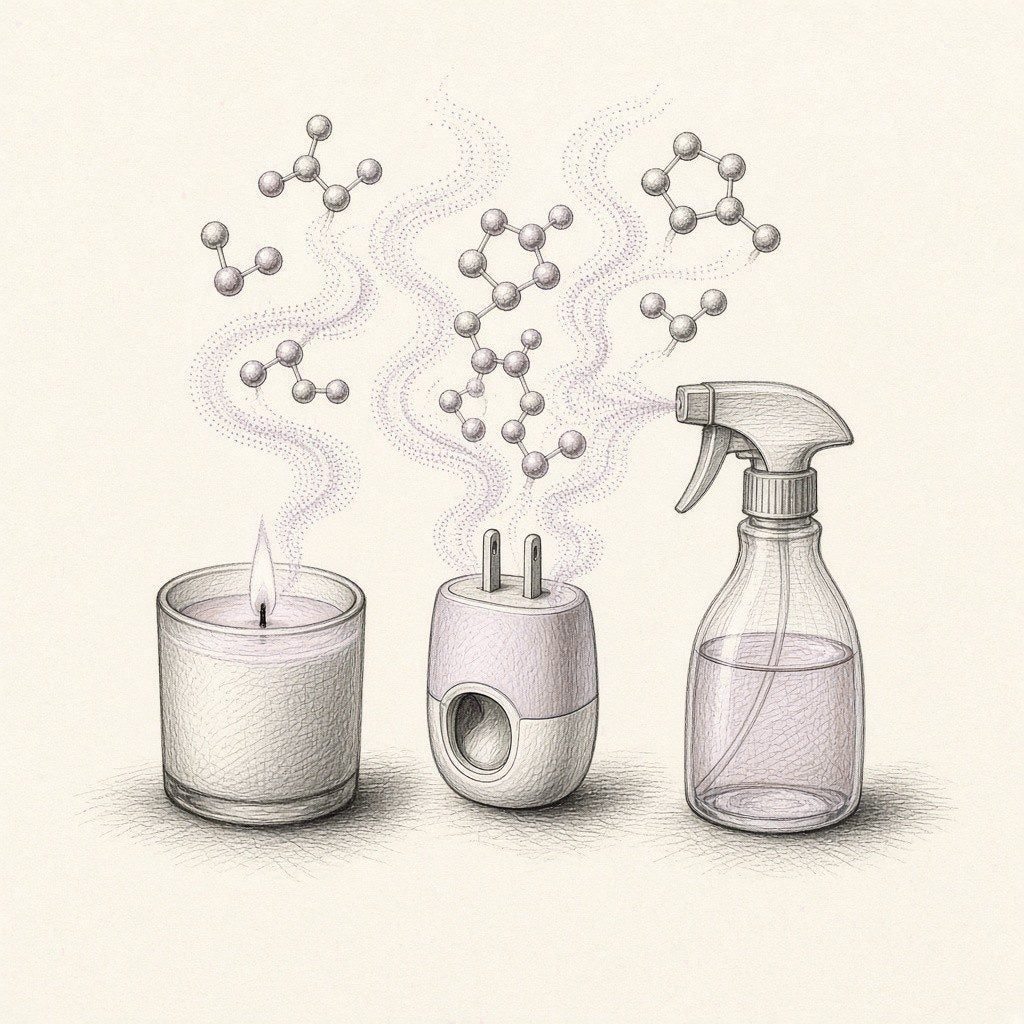
VOCs are gases emitted from certain solids or liquids, and concentrations of many of them are consistently higher indoors, up to ten times higher, than outdoors.[1] Their one weakness: they come from things you can find, so EPA’s first steps are the source and the window: increase ventilation when using products that emit VOCs.[1]
Tap any tag to see everything else that shares it.
Spot it: On product labels. EPA says to meet or exceed any label precautions.[1]
“Smells like lavender. Chemically, it's a group chat.”
The short version
- VOCs are gases emitted by a wide array of products numbering in the thousands, from paint to cleaners to hobby supplies.[1]
- Many VOCs are consistently higher indoors, up to ten times higher than outdoors.[1]
- EPA: at present, not much is known about what health effects occur from the levels of organics usually found in homes.[1]
What VOCs actually are
Organic chemicals are widely used as ingredients in household products. Paints, varnishes and wax all contain organic solvents, as do many cleaning, disinfecting, cosmetic, degreasing and hobby products.[1] Here’s one ordinary shelf.

- paint. Paints, paint strippers and other solvents.[1]
- aerosol. Aerosol sprays.[1]
- cleaner. Cleansers and disinfectants.[1]
- air freshener. Moth repellents and air fresheners.[1]
- glue. Glues and adhesives, permanent markers.[1]
Words, untangled
- VOCvolatile organic compound
- Emitted as gases from certain solids or liquids.[1]
- Organic solventthe carrier
- Found in paints, varnishes and wax, and many cleaning, cosmetic and hobby products.[1]
- Secondary pollutantthe sequel
- Terpenes such as limonene from fragranced products can generate secondary pollutants such as formaldehyde.[2]

The family
- Formaldehyde. One of the best known VOCs, and one of the few indoor air pollutants that can be readily measured.[1]
- Benzene. Main indoor sources: tobacco smoke, stored fuels, paint supplies and car exhaust in attached garages.[1]
- Methylene chloride. In paint strippers, adhesive removers and aerosol spray paints.[1]
- Perchloroethylene. The chemical most widely used in dry cleaning.[1]
- Terpenes (limonene). Emitted by fragranced products; they can generate secondary pollutants such as formaldehyde.[2]
Myths, meet sources
Air fresheners are on EPA’s list of VOC sources,[1] and fragranced products emit VOCs such as terpenes.[2]
“Gases can leak even from closed containers.”[1]
EPA’s TEAM study found common organic pollutants 2 to 5 times higher inside homes than outside, whether the homes were rural or highly industrial.[1]
Elevated concentrations can persist in the air long after the activity is completed.[1]
No federally enforceable standards have been set for VOCs in non-industrial settings.[1]
Some people, not everybody
“The ability of organic chemicals to cause health effects varies greatly from those that are highly toxic, to those with no known health effect.”US EPA, VOCs’ Impact on Indoor Air Quality [1]
“As with other pollutants, the extent and nature of the health effect will depend on many factors including level of exposure and length of time exposed.”US EPA, VOCs’ Impact on Indoor Air Quality [1]
Our part: we describe what the agencies say, word for word where it matters, not what it means for any one person.

Questions people ask
What counts as a VOC source?
Paints and solvents, wood preservatives, aerosol sprays, cleansers and disinfectants, moth repellents and air fresheners, stored fuels, hobby supplies, dry-cleaned clothing, building materials and furnishings, printers, glues and permanent markers.[1]
How much higher indoors?
Many VOCs are consistently up to ten times higher indoors. During and for several hours after paint stripping, levels may be 1,000 times background outdoor levels.[1]
What’s EPA’s first step?
Increase ventilation when using products that emit VOCs, and meet or exceed any label precautions.[1]
Should I keep half-used cans?
EPA: throw away partially full containers of old or unneeded chemicals safely, and buy only as much as you will use soon.[1]
Can I mix cleaning products?
EPA: never mix household care products unless directed on the label.[1]
Can VOCs turn into particles?
Yes. EPA says VOCs can react with other chemicals in the air or on surfaces to form more PM.[3]
Sources
- [1]US EPA, Volatile Organic Compounds’ Impact on Indoor Air QualityAgency guide
- [2]Steinemann (2016), Fragranced consumer products: exposures and effects from emissions, Air Quality, Atmosphere & Health 9:861-866Survey
- [3]US EPA, Sources of Indoor Particulate Matter (PM)Agency guide
Citing an agency or study doesn’t mean it endorses any product. Field names are ours. The science isn’t.
