

Pollen
Pollen vagans
A yellow car.
Spring morning. Every car on the street is wearing a thin yellow coat, and someone has written “wash me” in it with one finger. The trees look very pleased with themselves.
oh wow: Pollen is the first thing on EPA’s list of indoor particles ranked from largest to smallest,[1] and it doesn’t stay outside. Outdoor air brings particles in through open doors and windows and even small cracks, and pollen is one of the things it carries.[2] Some of that spring is already on your couch.
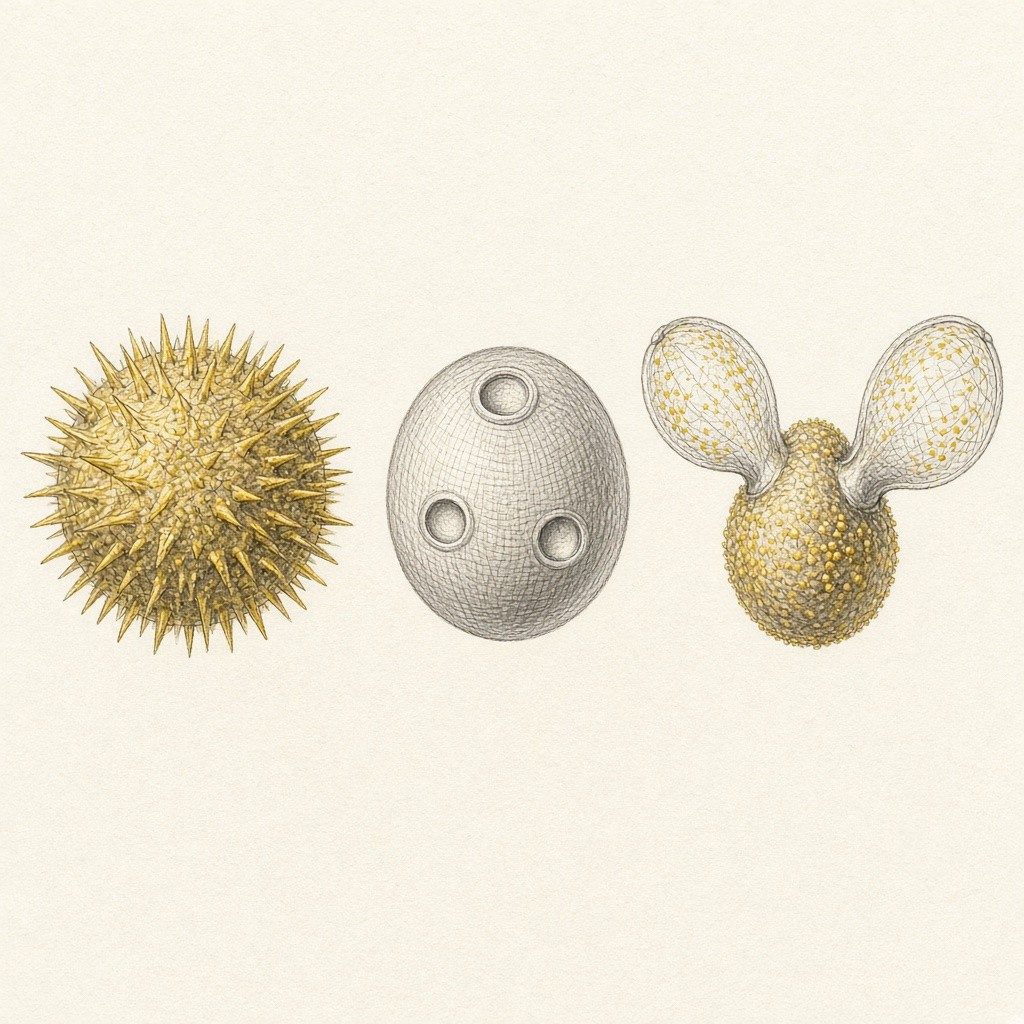
Pollen is an airborne allergen: tiny “seeds” dispersed from flowering plants, trees, grass and weeds.[3] It starts outdoors and rides in with outdoor air.[2] Its one weakness: it’s big, so it settles out of the air and onto surfaces rather rapidly.[1]
Tap any tag to see everything else that shares it.
Hang time: Settles. EPA groups pollen with the larger particles that settle out of the air and onto surfaces rather rapidly.[1]
Spot it: Outside, on high-pollen days. EPA suggests checking your local weather for the pollen count.[4]
“Plants mailing love letters. Your couch is not the address.”
The short version
What pollen actually is
Pollen comes from flowering plants, trees, grass and weeds, and the amount and type in the air depends on the season and geographic region.[3] Here’s the trip it takes, left to right.

- the plant. Flowering plants, trees, grass and weeds disperse it.[3]
- the breeze. How much is in the air depends on the season and the region.[3]
- one grain. One of the largest particles on EPA’s indoor list.[1]
- the window. Outdoor air brings it in through open doors and windows, and small cracks.[2]
Words, untangled
- Pollen countthe forecast
- EPA suggests checking your local weather for current temperature, humidity and pollen count.[4]
- Pollen seasonnot just spring
- Counts are typically higher during the warmer seasons, though some plants pollinate year-round.[3]
- Biological contaminantEPA’s word
- EPA lists pollen among the biological contaminants in indoor air.[4]

Myths, meet sources
“Though pollen counts are typically higher during the warmer seasons, some plants pollinate year-round.”[3]
Biological contaminants can make their way indoors through windows, doors, poorly maintained ventilation systems, plumbing and cracks.[4]
EPA says to avoid ventilating with outdoor air when outdoor air pollution or pollen is high,[4] and to keep your windows closed on high pollen days.[2]
EPA groups pollen with the larger particles that settle out of the air rather rapidly.[1]
Some people, not everybody
“Pollen is an airborne allergen that can affect our health.”US CDC, Allergens and Pollen [3]
“Individuals with respiratory conditions like asthma may be more sensitive to pollen.”US CDC, Allergens and Pollen [3]
Our part: we describe what the agencies say, word for word where it matters, not what it means for any one person.
Questions people ask
Why is there pollen indoors at all?
Outdoor and indoor air are constantly mixing together, and outdoor air carries pollen with it.[2]
When are pollen counts highest?
Typically during the warmer seasons, and the amount and type depends on the season and region.[3]
Should I open the windows on a high-pollen day?
EPA: keep your windows closed on high pollen days.[2]
Is climate change changing pollen season?
CDC says climate change may increase pollen concentrations and extend pollen seasons.[3]
Where does indoor pollen end up?
In dust. EPA lists pollen among the biological particles found in indoor dust.[2]
Sources
- [1]US EPA, Residential Air Cleaners: A Technical Summary, 3rd ed. (2018)Agency guide
- [2]US EPA, Sources of Indoor Particulate Matter (PM)Agency guide
- [3]US CDC, Allergens and PollenAgency guide
- [4]US EPA, Biological Pollutants’ Impact on Indoor Air QualityAgency guide
Citing an agency or study doesn’t mean it endorses any product. Field names are ours. The science isn’t.
