
The Field Guide to Air · Kitchen
Gas stove vs. induction: what happens to kitchen air
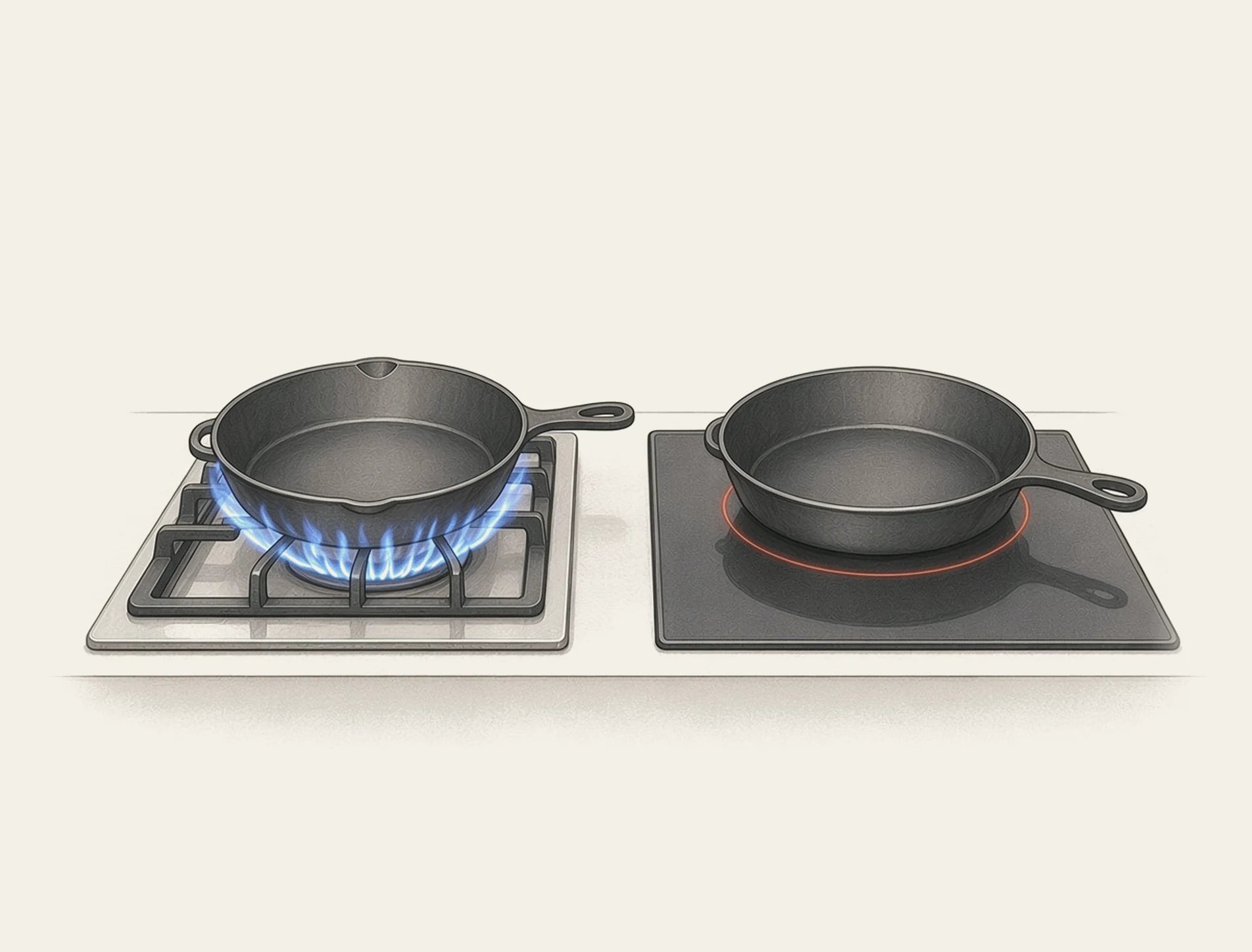
One skillet, two very different air stories. Here is what comes from the flame, what comes from the food, and what a range hood can actually catch.
TL;DR
Cooking sends two separate deliveries into your kitchen air: combustion gases like nitrogen dioxide and benzene from a gas flame, and fine smoke particles from the hot oil and food itself. Induction takes away the flame’s share, but searing still puts particles in the air on any stove. A hood vented outdoors, switched on every time and paired with the back burners, catches the most of both.
Put two identical skillets side by side. Same oil, same mushrooms, same heat. One sits on a ring of blue gas flame. The other sits on a slab of dark glass that never makes a flame at all. Now sear.
From across the room they look the same: a shimmer, a sizzle, and that smell that pulls everyone into the kitchen. In the air, though, they are telling two different stories at once.
Story one is about the flame. Burning natural gas is chemistry, and chemistry leaves leftovers. Story two is about the food. Hot oil, fat and browning sugars throw off a fog of tiny particles no matter what is heating the pan. Most kitchen arguments mash the two stories together. Pull them apart and the whole topic suddenly makes sense.
Story one: what the flame adds
A gas flame runs hot enough to split the nitrogen and oxygen in ordinary air and stitch them back together as nitrogen oxides, including nitrogen dioxide (NO2). EPA lists unvented gas stoves among the main indoor sources of NO2 and notes that in homes with gas stoves, indoor levels often exceed outdoor levels.9
Stanford researchers measured this directly. In 32 homes, Eric Lebel and colleagues found that nitrogen oxide emissions rose in a straight line with the amount of gas burned. Their data suggest a household that skips the range hood, or has poor ventilation, can pass the 100 ppb one-hour national NO2 standard within a few minutes of cooking, especially in a small kitchen.1
The same team found something stranger. Across 53 homes, stoves released 0.8% to 1.3% of the gas they used as unburned methane, and more than 75% of that methane escaped while the stove was off.1 Your stove keeps exhaling a little even when nobody is cooking.
Then came benzene. In 2023, Yannai Kashtan and colleagues sampled 87 stoves in California and Colorado. Gas and propane burners on high, and ovens set to 350°F, emitted an average of 2.8 to 6.5 micrograms of benzene per minute, 10 to 25 times more than electric coil and radiant stoves. The paper also notes that gas combustion indoors has been linked to carbon monoxide and formaldehyde. And here is the line worth circling: neither induction stoves nor the food being cooked emitted detectable benzene.2 The benzene belonged to the flame alone.

How far does it travel?
Kitchens are not sealed boxes. In 2024, Kashtan’s team measured NO2 in 18 homes, from 280 square foot apartments to 1,650 square foot houses, then used an airflow model built on NIST software to scale up. With no outside-venting hood running and just one burner, or one burner plus the oven, more than 50% of the kitchens, living rooms and bedrooms they tested went over EPA’s 100 ppb one-hour benchmark.3
Then they baked bread, or at least pretended to: oven at 475°F for 90 minutes, hood off, interior doors open. A sampling hose sat in the bedroom farthest from the kitchen, about 26 feet down the hall in most of the homes. In 3 of the 6 homes, that bedroom passed 100 ppb within 25 minutes. In 2 homes it stayed above that line for 2 to 3 hours after the oven was switched off.3 The oven was cold. The hallway was still busy.
A quick note on that yardstick. EPA’s 100 ppb figure is a National Ambient Air Quality Standard for outdoor air, judged on 1-hour values.8 EPA says no standards have been agreed upon for nitrogen oxides in indoor air.9 Researchers borrow the outdoor number because it is the clearest ruler anyone has.
Story two: what the food adds
Now the twist. Searing is its own little smoke machine. When oil gets hot and proteins and sugars brown, the pan throws off fine particles (PM2.5) and ultrafine particles, specks smaller than 0.1 micrometer. That part happens on any stove.
In the HOMEChem study, researchers cooked real meals in a test house and measured nearly everything. Cooking was the single largest source of indoor particle mass per activity, and during some meals PM2.5 topped 250 micrograms per cubic meter, briefly matching levels in the world’s most polluted cities. The same vegetable stir-fry averaged about 30 µg/m³ of PM2.5 on a propane stove and about 25 µg/m³ on an electric hot plate.5 For scale, EPA’s outdoor PM2.5 standard is 35 µg/m³ averaged over 24 hours.8 A dinner spike is a short burst, not a daily average, but the numbers live in the same neighborhood.
The quietest finding is the one that sticks: exposure during the decay after cooking was greater than exposure during the cooking itself.5 Dinner is served, the burner is off, and the air is still working.
None of this is new to aerosol scientists. Back in 2001, a team in Scotland fried bacon on gas and on electric rings and measured particles in the 50 to 100 nanometer range from both.6
What induction actually solves (and what it doesn’t)
The cleanest head-to-head comes from Lawrence Berkeley National Laboratory. Jiayu Li, Brett Singer and colleagues cooked the same meal (pasta, a plant-based meat sauce and stir-fried broccoli) three times on each cooktop in a test room of about 5,600 cubic feet.4
On gas, nitrogen oxides climbed for the whole meal and ended around 440 ppb above the starting level. On induction there was no discernible rise at all. Gas used twice as much energy to cook the same food. And with no hood running, ultrafine particle counts were nearly 100 times higher on gas, because the flame itself makes them.4
Here is the part the showroom skips. PM2.5 did not drop with induction. One pair of instruments measured 62% more PM2.5 on induction, a marginal result, while another pair found no discernible difference. Either way, the biggest particle spikes on both cooktops came from the same moment: stir-frying the broccoli. VOC levels did not differ significantly between the two cooktops either.4
One nerdy detail if you own a home air monitor: on gas, roughly 50% of the PM2.5 mass sat in particles smaller than 0.3 micrometer, below what many optical sensors can measure. A budget sensor may under-report gas cooking.4
So the scoreboard is simple. Induction removes the flame’s whole story: the NO2, the benzene, the unburned methane and most of the ultrafines, plus a lot of wasted heat. It does nothing about the food’s story. A steak seared on glass still smokes like a steak.
The kitchen air playbook, gas or induction
Good news: the moves are the same on any stove, and most of them cost nothing.
1. Run the hood every time, not just when the alarm yells. Kashtan’s team cites surveys showing range hoods get used only 15% to 39% of the time. In 5 homes, outside-venting hoods lowered hour-averaged kitchen NO2 by 10% to 70%, a 35% average.3 EPA’s own advice for gas stoves is an exhaust fan vented to the outdoors.9 Start it before the oil heats and let it run after the pan comes off, since the air stays busy after dinner.5
2. Cook on the back burners. In a 2012 LBNL lab test of seven hoods, the share of burner exhaust captured ranged from under 15% to over 98%. At the industry-recommended airflow (118 L/s, about 250 cubic feet per minute), hoods caught about 80% or more from the back burners but only about 50% or more from the front. At the minimum airflow in ASHRAE and HVI guidance, it was about 60% at the back and 25% to 30% at the front.7 Back burners sit under the hood. Front burners often stick out past it. That test measured burner exhaust over pots of water rather than sizzling food, but the geometry lesson carries over.
3. If your hood only recirculates, add outdoor air. In the LBNL meal test, two recirculating hoods with filters still lowered particle exposure by 40% to 80%, and one of them also lowered many VOCs. But they generally did not change the combustion gases in the room, though one did lower NO2.4 A recirculating hood can’t send gas outside. A cracked window can.
4. Let filtration mop up what lingers. EPA puts it in order: reduce the source, ventilate with outdoor air, and use filtration as a supplement. For gases and odors, EPA points to activated carbon, and notes that more material in the filter is better.10 That is the job for the lingering haze and the smell of last night’s salmon, after the hood has done its part.

So, gas or induction? If you are choosing, induction lifts the flame’s entire chapter out of your air. If you are keeping gas, the hood and the back burners do a surprising amount of the work. And on either one, the steak still gets the last word. Sear it with the fan on.
Jaspr is an air scrubber, not a medical device.
Keep reading
 Down the rabbit holeParticles: the stuff that floats, and the stuff that fallsWhere the sizzle goes after the pan: how long fine specks stay up.
 Down the rabbit holeHow to test your home’s air (without freaking out)Want to see your own kitchen spike? Here is how to measure it calmly.
 Back to the startIndoor Air 101: What’s actually floating around your homeThe whole Field Guide, from the top.
