
The Field Guide to Air · Mold spores
Most of the mold in your air is invisible
Field name: Sporae fungorum. Mold spores and fragments are already in indoor and outdoor air, and almost none of that exposure looks like a patch on a wall. Here is what research can actually say about the invisible particles, the hidden growth, and the mycotoxins that sometimes travel with them.
TL;DR
Mold is already in the air, indoors and out. CDC notes there is always some mold around, and EPA says the spores themselves are invisible to the naked eye. Indoor growth is often hidden behind drywall, under carpet, or inside ductwork. When mold does grow, fragments smaller than intact spores can outnumber the spores themselves and stay airborne longer. Some molds, under some conditions, produce mycotoxins, which researchers have detected on spores, smaller fragments, and house dust; WHO still finds it unclear whether indoor airborne levels are high enough to matter for health, and calls the evidence that they play a role in indoor-air health problems extremely weak. None of it grows without moisture, so the first move is still to find the water and remove the growth.
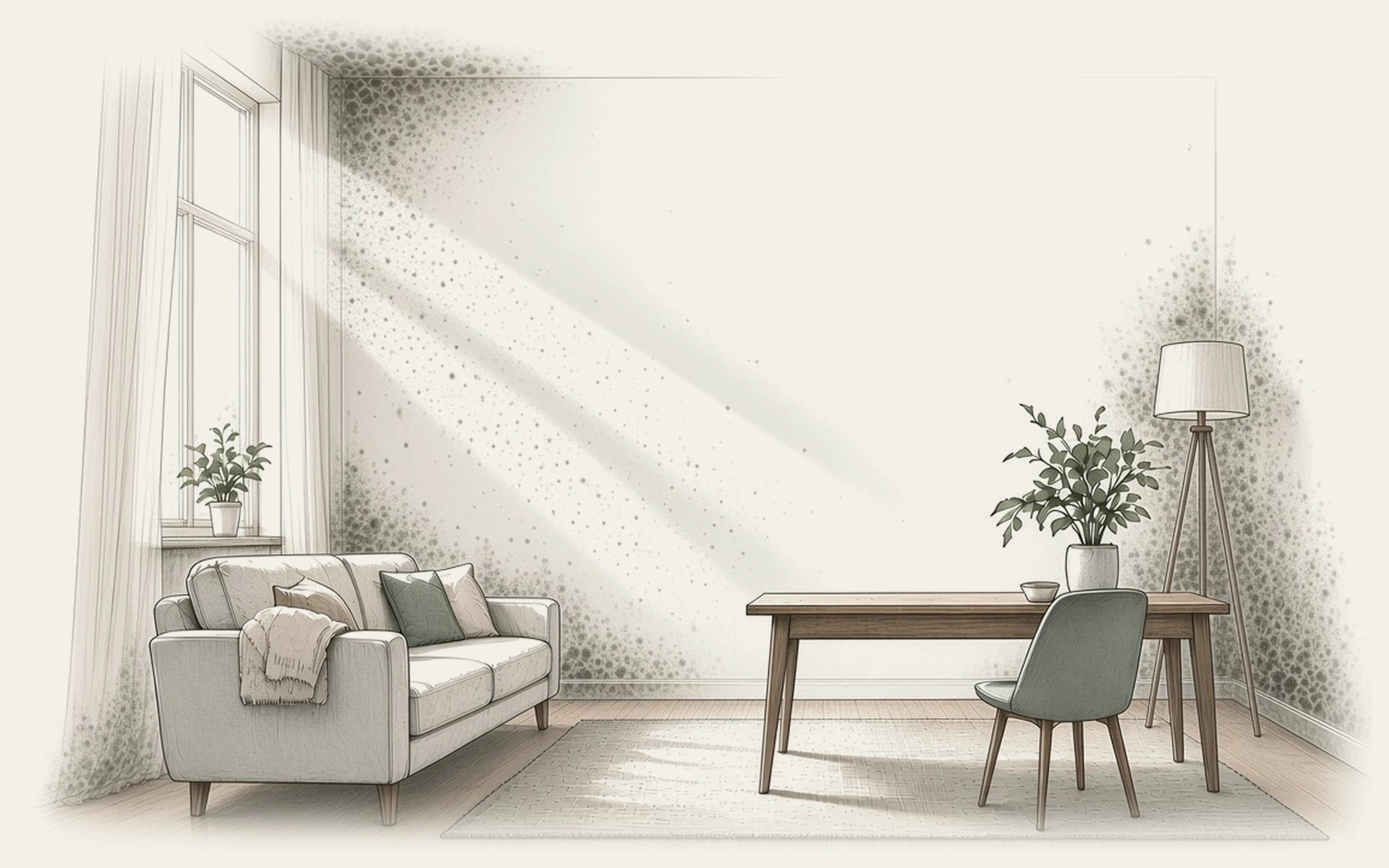
The room can look perfectly ordinary. A sofa, a table, a bit of sun on the rug. Then a sunbeam cuts through the air, and a slow drift of motes shows up for a second. Most of what is actually in that air, you will never see.
Mold is not rare, and it is not only a stain on a wall. Outdoors, molds help break down dead leaves and wood. Their microscopic spores (our field name: Sporae fungorum) float through outdoor and indoor air all the time.13 CDC puts it plainly: there is always some mold around.2 It comes indoors through open doors, windows, vents, and heating and air conditioning systems, and it hitches a ride on clothing, shoes, bags, and pets.2 EPA adds the part that is easy to forget: the spores themselves are invisible to the naked eye.1
You are breathing some of them as you read this.123 That does not mean a house is failing an inspection. It means mold is a normal part of air, the way dust is. Spores sit in room air and house dust without growing, waiting for one ingredient: water.13 The problem starts when they land on something wet and begin to grow indoors, often out of sight.1
What you are actually inhaling
Saying “mold” as if it were one object hides several different things. WHO defines moulds as microscopic fungi that grow as multicellular threads called hyphae; when those threads branch into a connected network, the whole colony is a mycelium.5 That mat is what people picture on damp drywall or a bathroom tile. Most of what you actually breathe is not the mat. It is what the mat sheds into the air.
Intact spores are the travelers. Molds reproduce by shedding microscopic spores, typically 2 to 10 micrometers across according to EPA’s mold overview and WHO, though across species EPA notes spores can span from 2 to 100 micrometers.453 For scale, EPA puts an average human hair at about 70 micrometers wide, so a 10 micrometer spore is about 14% of a hair’s width.6 Some spores are dry and easily kicked back into the air when someone walks past or vacuums; others are sticky and cling until brushed.4 Spores in the 2 to 10 micrometer range behave like coarse particles and settle onto surfaces relatively quickly once the air goes still.
Mold fragments are the smaller crowd that standard air tests miss. As a colony ages, dries, or gets disturbed by airflow, bits of hyphae and fractured spores break off into particles both larger than 1 micrometer and smaller than 1 micrometer.57 In a University of Cincinnati chamber study counting particles down to 0.3 micrometers across three common indoor molds (Aspergillus versicolor, Penicillium melinii, and Cladosporium cladosporioides), fragments smaller than 1.6 micrometers outnumbered intact spores by 7 to 320 times depending on the species and air speed.7 Subsequent chamber testing cited by WHO pushed that ratio as high as 514 times.5
Those ratios are from controlled chambers, not a typical living room. Field measurements are smaller but still point the same way. In five water-damaged homes, Reponen and colleagues found that the mass of fungal cell-wall material, measured as (1→3)-β-D-glucan, on submicron particles ranged from about 1% of the spore-sized mass in one home to more than twice the spore-sized mass in another.8 In moldy basements, Afanou and colleagues counted an average fragment-to-spore ratio of 1.7 indoors, compared with 0.32 in the outdoor air just outside those buildings.9 Because the fragments are smaller than intact spores, they behave like other fine particles and remain suspended longer. That is why the air can hold a lot of mold even when nothing looks wrong on the wall.

Most indoor growth is hidden
Visible fuzz is the exception, not the rule. EPA notes that you may suspect hidden mold if a building smells musty but you cannot see the source, or if you know there has been water damage.1 Growth can sit on the back of drywall, wallpaper, or paneling, on top of ceiling tiles, on the underside of carpets and pads, inside walls around leaking or condensing pipes, on walls behind furniture where condensation forms, inside ductwork, and in roof materials above ceiling tiles.1 Opening those cavities can send a large pulse of spores into the room, which is why EPA advises caution, and hiring an experienced professional if you think hidden growth is involved.1
That is the other half of invisibility. The particles are too small to see, and the colony that produced them may be behind a wall, under a carpet, or in the heating and air conditioning system.
Mycotoxins: what they are, and whether they float
Mycotoxins are a different kind of thing from spores and fragments. They are not the fungus itself, and they are not the musty gases that make a room smell damp. WHO describes them as low-relative-molecular-mass chemicals produced by fungi, some of which are toxic to animals and people.5 A standard review by Bennett and Klich defines them as low-molecular-weight secondary metabolites made by filamentous fungi.10 Secondary, here, just means the mold makes them as a byproduct of its chemistry, not as a building block of its body.
Not every mold makes them, and a mold that can make them does not do so all the time. EPA’s mold course is direct: as molds grow, some (but not all) of them may produce mycotoxins under some conditions.3 More than 200 mycotoxins from common molds have been identified, and many more remain to be identified.3 The amount and types depend on many environmental and genetic factors. No one can tell whether a mold is producing mycotoxins just by looking at it.3 “Black mold” and “toxic mold” are not species names. EPA notes that the news media sometimes use those phrases for molds that may produce mycotoxins, or for one species in particular, Stachybotrys chartarum.3
Which molds have been studied most carefully for indoor air? The mycotoxins that have received the most attention in damp buildings, WHO writes, are the trichothecenes produced by Stachybotrys chartarum.5 Aspergillus versicolor can produce sterigmatocystin.5 Aspergillus flavus and Aspergillus parasiticus are the source of aflatoxin, a mycotoxin studied mainly in food and animal feed rather than in ordinary homes.510 Some Penicillium species produce compounds such as penicillin, a strong antibiotic, which is a reminder that “a chemical made by a mold” is a wide category, not a single poison.5
Do those chemicals become airborne? That is the research question, and the evidence is real but uneven. Mycotoxins are not gases. When they leave a surface, they travel on particles: intact spores, smaller fungal fragments, or settled dust that later gets stirred up.51112
In laboratory work, Brasel and colleagues showed that trichothecene mycotoxins from Stachybotrys chartarum can become airborne on both intact spores (conidia) and on particles smaller than spores.11125 WHO also reports a laboratory demonstration that sterigmatocystin can aerosolize from a finishing material at an airflow of 100 centimeters per second and a relative humidity of 30%.515
In buildings, the picture is mixed. Brasel and colleagues sampled seven buildings known to be contaminated with Stachybotrys chartarum and found airborne levels of macrocyclic trichothecenes significantly higher than in four control buildings with no detectable Stachybotrys and no history of water damage.115 Bloom and colleagues, as summarized by WHO, detected mycotoxins produced by Stachybotrys chartarum and Aspergillus versicolor (including macrocyclic trichothecenes, trichodermin, sterigmatocystin, and satratoxin G) in building materials and settled dust from buildings with current or past damp or water damage.135 A comparison by Charpin-Kadouch and colleagues of 15 flooded dwellings known to be contaminated with Stachybotrys chartarum or Chaetomium, and nine dwellings without visible mold, found significantly higher macrocyclic trichothecenes in floor dust from the moldy houses, and a weaker difference in wall samples, but no statistically significant difference in air concentrations.145
WHO’s own summary of this literature is the honest one to keep: these studies show that mycotoxins are present in the indoor environment, and that levels may be higher in buildings affected by mold or damp.5 It is still not clear whether the levels of airborne mycotoxins in damp buildings are sufficiently high to cause adverse health effects.5 In a later chapter, WHO goes further: although mycotoxins can induce a wide range of adverse effects in animals and people, “the evidence that they play a role in health problems related to indoor air is extremely weak.”5
Most documented mycotoxin harm in people comes from eating contaminated food, not from breathing house air. Bennett and Klich note that mycotoxins usually enter the body through contaminated foods, though inhalation of spore-borne toxins and skin contact are also routes of exposure.10 EPA’s practical advice stays modest: some mycotoxins are known to affect people, but for many, little health information is available, research is ongoing, and it is prudent to avoid unnecessary inhalation exposure to mold.3 That is a reason to find the moisture and remove the growth. It is not a reason to treat every musty room as proof of a toxin in the air.
The musty smell is a gas, not a mycotoxin
The smell people notice is usually something else. Many fungi release a mixture of gases called microbial volatile organic compounds, or MVOCs, which can smell musty, earthy, or like a basement.53 WHO notes that more than 200 of these compounds have been identified, and that they are often similar to ordinary industrial chemicals.5 A musty odour can be a useful clue that hidden growth is present, which is how EPA frames hidden-mold investigations.1 It is not a reliable test by itself, and it is not a measurement of mycotoxins.
Moisture still decides whether it grows
None of this changes the basic switch. Mold spores are already in the air; they do not grow indoors without moisture.13 EPA and CDC emphasize drying water-damaged materials and spills within 24 to 48 hours.12 For day-to-day air, EPA recommends keeping indoor relative humidity below 60%, and ideally between 30% and 50%; CDC sets the ceiling at 50% or lower.12
Dampness itself is common. WHO estimates that damp conditions affect roughly 10% to 50% of indoor environments in affluent countries, and a major U.S. epidemiology review cites estimates of 18% to 50% across buildings.518 Nutrients are almost never the missing piece: CDC and EPA list paper, cardboard, drywall, wood, carpet, fabric, upholstery, insulation, and settled house dust as ready food.123
The cold-spot trap still explains why mold appears in a house where the hallway hygrometer reads a comfortable number. As WHO’s moisture chapter illustrates, room air sitting at 20 °C (68 °F) and 58% relative humidity carries no visible water.5 Yet when that exact same air drifts up against a poorly insulated outer wall at 15 °C (59 °F), its local relative humidity jumps to 75%.5 Touch a cold window glass at 11 °C (52 °F), and the air hits 100% relative humidity and leaves liquid condensation behind.5 Different indoor molds thrive at different moisture thresholds on a surface: primary colonizers such as many Penicillium and Aspergillus species can start growing below 80% equilibrium relative humidity, secondary colonizers such as Cladosporium need 80% to 90%, and water-hungry tertiary molds such as Stachybotrys chartarum generally need more than 90% from leaks, flooding, or heavy condensation.5
Why a short air test is a weak snapshot
If you suspect mold, the first instinct is often to buy a mail-in dish or book an air test. CDC states plainly: “CDC does not recommend mold testing.”2 EPA agrees that if visible mold growth is present, sampling is usually unnecessary.116 There are no EPA or federal health limits for airborne mold or mold spores, so no lab printout can tell you whether a room passes or fails a standard.116 And whether you find Cladosporium, Penicillium, or Aspergillus, the fix is the same: remove the mold and stop the water source.2
A standard short airborne culture plate only catches spores that happen to be floating during that window and are still able to grow on that particular dish.5 It misses dead spores, slow growers, and most submicron fragments.57 WHO cites modeling that, because indoor spore levels swing so widely over time and from room to room, researchers would need 27 to 36 air samples per house just to estimate average culturable indoor fungi within a 10% bias.5

What actually changes the air
Find and stop the water. Fix leaky roofs, plumbing drips, and overflowing air-conditioner drain pans, and dry wet materials within 24 to 48 hours.12 If moisture soaked porous materials like ceiling tiles or carpet that cannot be dried quickly, EPA and CDC advise replacing them.12
Hold humidity in the dry zone. A simple humidity meter tells you where a room stands.1 Aim for 30% to 50% relative humidity (and stay below 60%) using exhaust fans vented outdoors in bathrooms and kitchens, dehumidifiers, air conditioning, and insulation on cold pipes or drafty surfaces where condensation forms.12
Remove the growth, including material that is no longer living. EPA notes that mold does not have to be alive to cause an allergic reaction in some people, so a biocide or disinfectant is not a substitute for taking the mold away.31 If mold covers less than about 10 square feet (roughly a 3-by-3-foot patch), EPA says homeowners can usually scrub it off hard surfaces with detergent and water and dry completely.1 Larger jobs, hidden mold inside walls or HVAC ducts, or sewage backups call for experienced professionals.116 EPA does not recommend routine spraying of chlorine bleach or other biocides, and warns never to mix bleach with ammonia.12
Know what air cleaners can and cannot do. EPA’s Guide to Air Cleaners in the Home is direct: portable air cleaners and HVAC filters cannot solve a mold problem, because they do not dry a wet surface or fix a leak.17 An air cleaner with a high-efficiency particle filter can capture airborne spores and smaller fungal fragments floating in the room, and a filter with activated carbon can help reduce odours, while you fix the moisture and remove the source.17
Jaspr is an air scrubber, not a medical device.
Keep reading
 Down the rabbit holeRooms: same air, different neighborhoodsBathrooms, basements, and why one corner of a house grows mold while the hallway stays dry.
 Down the rabbit holeBedroom air: a small room with the door shutHow closed doors change indoor moisture, CO2, and particles overnight.
 Down the rabbit holeWhy you can’t smell your own houseWhy your nose stops noticing a faint musty smell within minutes.
